
Buying wisely ·
KONG Classic: product identity and the weight-chart discrepancy
KONG’s own pages disagree on one KONG Classic size: the Classic product page lists Medium for dogs 15 to 35 lbs, while the Choosing the Right KONG guide lists Medium for 5 to 35 lbs.
 By Claire Benning, Reviews editor · 1 min read · Published · Updated
Identify the red Classic before comparing charts
KONG’s own pages disagree on one KONG Classic size: the Classic product page lists Medium for dogs 15 to 35 lbs, while the Choosing the Right KONG guide lists Medium for 5 to 35 lbs. The other five sizes match. Before comparing charts, confirm which toy you’re holding. The KONG Classic product page lists the animal as Dog, the color as Red, and six single sizes: X-Small, Small, Medium, Large, X-Large, and XX-Large. At the top of the listing it shows SKU T4 and UPC 035585125008. That SKU and UPC pair identifies one size, not the whole six-size Classic lineup.
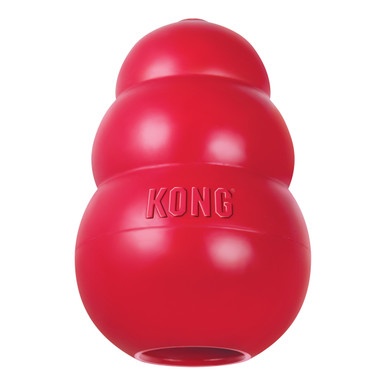
Open the Specs tab and six separate SKU and UPC pairs appear, each with its own dimensions and listed weight:
| SKU | UPC | Dimensions | Weight |
|---|---|---|---|
| T4 | 035585125008 | 1.5 by 1.5 by 2.25 in | 0.06 lbs |
| T3 | 035585111315 | 1.75 by 1.75 by 3 in | 0.11 lbs |
| T2 | 035585111216 | 2.25 by 2.25 by 3.5 in | 0.25 lbs |
| T1 | 035585111117 | 2.75 by 2.75 by 4 in | 0.45 lbs |
| KXL | 035585111018 | 3.5 by 3.5 by 5 in | 0.77 lbs |
| KK | 035585111414 | 3.88 by 3.88 by 6 in | 1.21 lbs |
The Specs section does not pair these codes with size names. Use the SKU, UPC and dimensions together to identify the variant; confirm its size label with the seller. If a seller quotes you a Classic by SKU alone, measure or ask for dimensions before assuming which of the six you’re being sold. The catalogue address kongcompany.com/catalogue/KK is built around one of those codes and now redirects to the main Classic page, which is a useful reminder that a KONG URL can point at a single item code while the page it lands on covers all six.
Every listing describes the Classic the same way: a natural red rubber formula for average chewers, distinct from the pink and blue Puppy line or the black Extreme line sold under the same KONG umbrella. The page says to supervise use, remove packaging and attachments, and stop using a damaged toy. Its power-chewer advice varies by variant, including sizing up or choosing KONG Extreme; check the warning for the exact item.

That distinction matters because KONG sells multiple colors of similarly shaped toys, and the sizing conversation on the company’s own Choosing the Right KONG page addresses all of them together. The color coding is one way to confirm you’re reading about the Classic specifically:
- Red: KONG Classic, for average chewers
- Pink/Blue: KONG Puppy, for puppies nine months old and younger, and for light chewers
- Purple: KONG Senior, for older or gentle chewers
- Black: KONG Extreme, for the most powerful chewers
Before you place a weight chart next to a size selector, confirm the item you’re comparing carries the red rubber designation. Skipping that step is how shoppers end up applying a Puppy or Extreme guideline to a Classic purchase, or the reverse.

Put the two weight references side by side
Two KONG-owned pages publish different weight ranges for the same size labels, and neither one reconciles the difference. The blog post does link to the Classic in a products block at the bottom, so these aren’t strangers to each other; the numbers still don’t match. That’s the core discrepancy a buyer needs to see plainly before picking a size.

The product page lists these ranges directly on the Classic’s own listing:
| Size | Product Page Range |
|---|---|
| X-Small | Up to 5 lbs |
| Small | Up to 20 lbs |
| Medium | 15-35 lbs |
| Large | 30-65 lbs |
| X-Large | 60-90 lbs |
| XX-Large | 85+ lbs |
The Choosing the Right KONG blog post gives a “general guideline based on your dog’s weight” that differs at the Medium tier:
| Size | Choosing Guide Range |
|---|---|
| XS | Up to 5 lbs |
| S | Up to 20 lbs |
| M | 5-35 lbs |
| L | 30-65 lbs |
| XL | 60-90 lbs |
| XXL | 85 lbs and over |
Line them up and the gap shows at Medium: the product page states 15-35 lbs, while the guidance article states 5-35 lbs. Both pages agree on X-Small, Small, Large, X-Large, and XX-Large.
Neither page flags the Medium figure as an update, a typo, or a regional variant. Both were available when checked on September 13, 2026, both are published by the same company, and both use the identical size label “Medium” for two different lower bounds.
No footnote on either page explains the ten-pound gap. That leaves the buyer to reconcile the numbers, since the manufacturer doesn’t resolve them in the copy itself.

Which KONG Classic size fits a 5 to 15 lb dog?
A published range gap doesn’t cancel out the sizing guidance; it just means the lower boundary of Medium isn’t fixed across KONG’s own materials. For a dog weighing at least 5 but less than 15 pounds, the two lower bounds give different answers to whether Medium includes that weight.
The product page’s 15-35 lbs range would exclude that dog from Medium and point toward Small (up to 20 lbs), while the blog’s 5-35 lbs range would include that same dog in Medium.

Neither page states which range takes precedence, and nothing in the reference material indicates one page is a corrected update of the other. Treating this as a fixed rule risks misreading the manufacturer’s intent, since both figures currently exist as published guidance without a resolution note attached.
The Choosing the Right KONG page does offer a second, weight-independent method: check head and mouth size, and confirm the largest ring of the KONG is bigger than the back of the dog’s mouth. It also advises sizing to the largest dog in a multi-dog household as a safety precaution, and sizing up when a dog falls between two categories.
For a dog weighing at least 5 but less than 15 pounds, ask KONG to clarify the Medium lower limit before relying on it. The maker’s mouth-size guidance adds a separate consideration; it does not reconcile the two published numbers.
Outside that disputed lower interval, the printed weight ranges agree. Agreement does not establish a correct size for an individual dog: the ranges overlap and KONG also discusses mouth size and chewing style.
Care instructions belong to the exact toy
The cleaning page covers the entire KONG rubber toy line, including the Classic. It is broader than a red-Classic-only instruction. The company’s how-to-clean-a-KONG page describes rinsing with warm water and dish soap, soaking to loosen stubborn residue like dried peanut butter, and scrubbing the interior with a KONG brush or old toothbrush before a thorough rinse.
The same page states that KONG rubber toys are top-rack dishwasher safe, with one specific caveat: skip the drying cycle, since excess heat can damage the toy. It also suggests a chopstick as a tool for poking out treats stuck in the opening, and recommends keeping a few stuffed KONGs in the freezer as a rotation option.

This care guidance applies to “KONG Rubber toys” as a group, without singling out one color. Still, confirming the toy in your hands is the red Classic, distinguishing it from a Puppy, Senior, or Extreme toy purchased alongside it, keeps you working from the correct product identity established on the Classic’s own listing. KONG’s own sizing article says the color of a rubber toy signals its durability and the chewing style it suits, which is why the lines stay distinct from each other even under one shared cleaning method.
Skip the drying cycle, rinse thoroughly, and keep the toy identity clear each time you replace or size up.